Back Cover

SINGAPORE’S MONUMENTS & LANDMARKS: A PHILATELIC RAMBLE
This fascinating book presents the various stamps which feature Singapore landmarks of the past and present. It contains full-coloured, enlarged prints of the stamps, as well as interesting information about the natural and man-made landmarks in Singapore. This beautiful work will appeal to the young and old. Discover our history, heritage and environment as you go on an enjoyable philatelic journey of our landmarks.
ABOUT THE AUTHORS
Tan Wee Kiat is a retired lecturer from the National Institute of Education. He is a stamp enthusiast and is dedicated to using philately as a tool to educate our young. He has written 7 stamp-based books for Singaporean youngsters.
Edmund WK Lim is a Teaching Fellow at the National Institute of Education. His research interests are wide and varied. His previous published work include a commemorative book on the Chased-el Synagogue.
Kevin YL Tan is an independent legal and history scholar. He has written and edited numerous books on Singapore law, politics, and history. He is currently the President of the Singapore Heritage Society.
Page 96
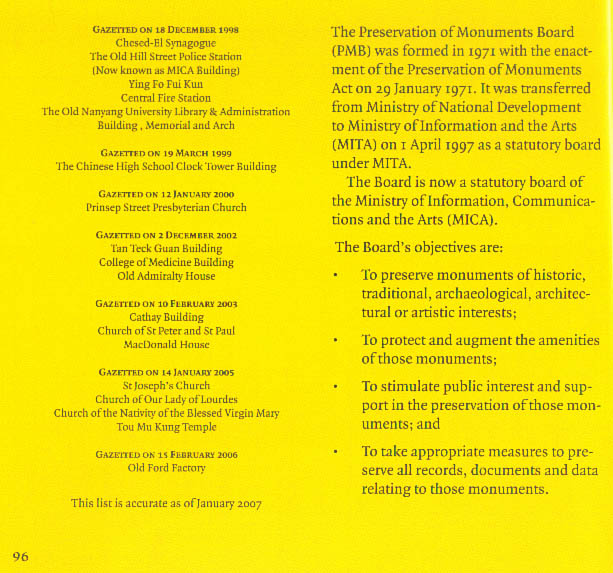
NATIONAL MONUMENTS (Cont’d)
(This list is accurate as of January 2007)
Gazetted on 18 December 1998
Chesed-El Synagogue The Old Hill Street Police Station (now known as MICA Building) Ying Fo Fui Kun Central Fire Station The Old Nanyang University Library & Administration Building, Memorial and ArchGazetted on 19 March 1999
The Chinese High School Clock Tower Building
Gazetted on 12 January 2000
Prinsep Street Presbyterian Church
Gazetted on 2 December 2002
Tan Teck Guan Building College of Medicine Building Old Admiralty HouseGazetted on 10 February 2003
Cathay Building Church of St Peter and St Paul MacDonald HouseGazetted on 14 January 2005
St Joseph’s Church Church of Our Lady of Lourdes Church of the Nativity of the Blessed Virgin Mary Tou Mu Kung TempleGazetted on 15 February 2006
Old Ford Factory
The Preservation of Monuments Board (PMB) was formed in 1971 with the enactment of the Preservation of Monuments Act on 29 January 1971. It was transferred from Ministry of National Development to Ministry of Information and the Arts (MITA) on 1 April 1997 as a statutory board under MITA.
The Board is now a statutory board of the Ministry of Information, Communications and the Arts (MICA).
The Board’s objectives are:
- To preserve monuments of historic, traditional, archaelogical, architectural or artistic interests;
- To protect and augment the amenities of those monuments;
- To stimulate public interest and support in the preservation of those monuments; and
- To take appropriate measures to preserve all records, documents and data relating to those monuments.
Page 95
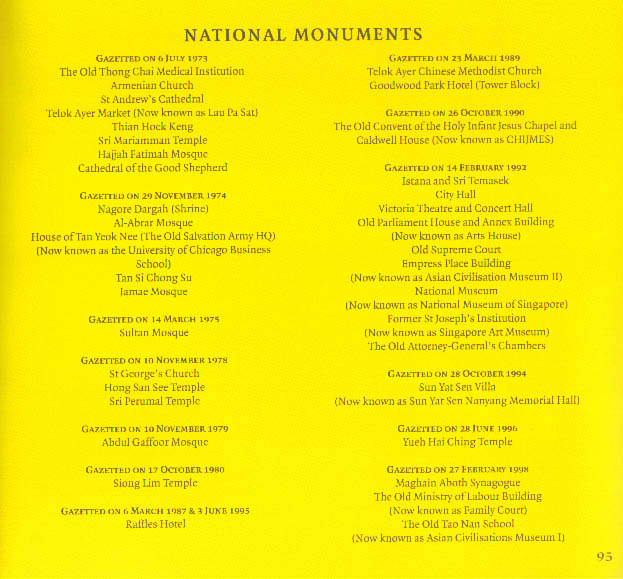
NATIONAL MONUMENTS
(This list is accurate as of January 2007)
Gazetted on 6 July 1973
The Old Thong Chai Medical Institution Armenian Church St Andrew’s Cathedral Telok Ayer Market (now known as Lau Pa Sat) Thian Hock Keng Sri Mariamman Temple Hajjah Fatimah Mosque Cathedral of the Good ShepherdGazetted on 29 November 1974
Nagore Dargah (Shrine) Al-Abrar Mosque House of Tan Yeok Nee (the Old Salvation Army HQ, now known as the University of Chicago Business School) Tan Si Chong Su Jamae MosqueGazetted on 14 March 1975
Sultan Mosque
Gazetted on 10 November 1978
St George’s Church Hong San See Temple Sri Perumal TempleGazetted on 10 November 1979
Abdul Gaffoor Mosque
Gazetted on 17 October 1980
Siong Lim Temple
Gazetted on 6 March 1987 & 3 June 1995
Raffles Hotel
Gazetted on 23 March 1989
Telok Ayer Chinese Methodist Church Goodwood Park Hotel (Tower Block)Gazetted on 26 October 1990
The Old Convent of the Holy Infant Jesus Chapel and Caldwell House (Now known as CHIJMES)Gazetted on 14 February 1992
Istana and Sri Temasek City Hall Victoria Theatre and Concert Hall Old Parliament House and Annex Building (now known as Arts House) Old Supreme Court Empress Place Building (now known as Asian Civilisation Museum II) National Museum (now known as National Museum of Singapore) Former St Joseph’s Institution (now known as Singapore Art Museum) The Old Attorney-General’s ChambersGazetted on 28 October 1994
Sun Yat Sen Villa (now known as Sun Yat Sen Nanyang Memorial Hall)Gazetted on 28 June 1996
Yueh Hai Ching TempleGazetted on 27 February 1998
Maghain Aboth Synagogue The Old Ministry of Labour Building (now known as Family Court) The Old Tao Nan School (now known as Asian Civilisations Museum I)Page 94
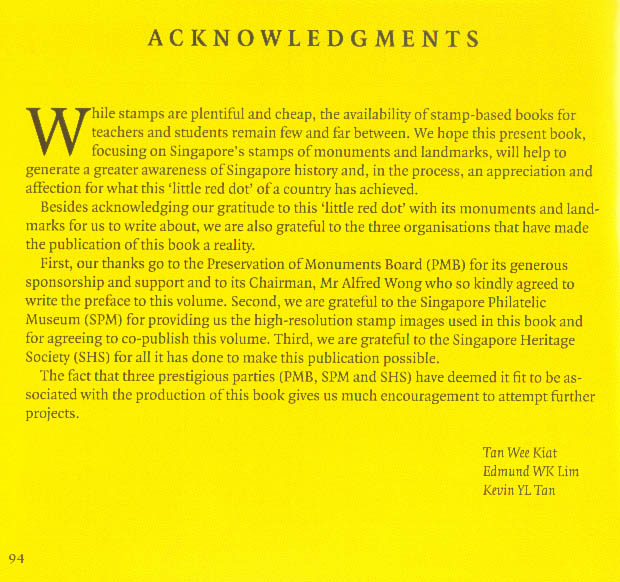
ACKNOWLEDGMENTS
While stamps are plentiful and cheap, the availability of stamp-based books for teachers and students remain few and far between. We hope this present book, focusing on Singapore’s stamps of monuments and landmarks, will help to generate a greater awareness of Singapore history and, in the process, an appreciation and affection for what this ‘little red dot’ of a country has achieved.
Besides acknowledging our gratitude to this ‘little red dot’ with its monuments and landmarks for us to write about, we are also grateful to the three organisations that have made the publication of this book a reality.
First, our thanks go to the Preservation of Monuments Board (PMB) for its generous sponsorship and support and to its Chairman, Mr Alfred Wong who so kindly agreed to write the preface to this volume. Second, we are grateful to the Singapore Philatelic Museum (SPM) for providing us the high-resolution stamp images used in this book and for agreeing to co-publish this volume. Third, we are grateful to the Singapore Heritage Society (SHS) for all it has done to make this publication possible.
The fact that three prestigious parties (PMB, SPM and SHS) have deemed it fit to be associated with the production of this book gives us much encouragement to attempt further projects.
Tan Wee Kiat Edmund WK Lim Kevin YL TanPage 93
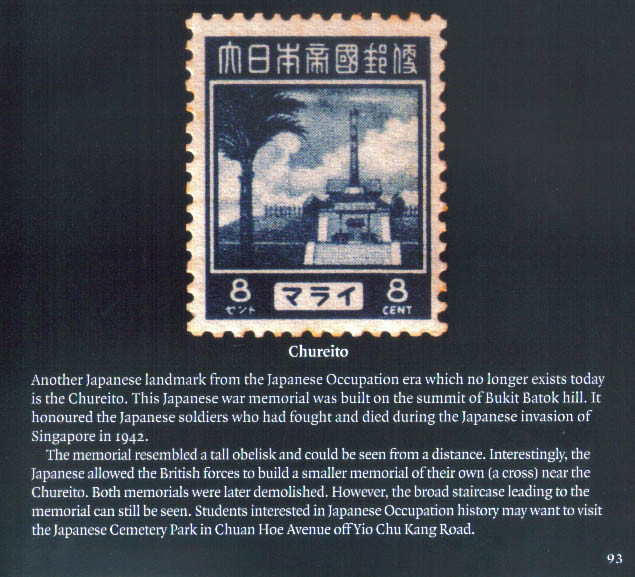
Chureito
Another Japanese landmark from the Japanese Occupation era which no longer exists today is the Chureito. This Japanese war memorial was built on the summit of Bukit Batok hill. It honoured the Japanese soldiers who had fought and died during the Japanese invasion of Singapore in 1942.
The memorial resembled a tall obelisk and could be seen from a distance. Interestingly, the Japanese allowed the British forces to build a smaller memorial of their own (a cross) near the Chureito. Both memorials were later demolished. However, the broad staircase leading to the memorial can still be seen. Students interested in Japanese Occupation history may want to visit the Japanese Cemetery Park in Chuan Hoe Avenue off Yio Chu Kang Road.
Page 92
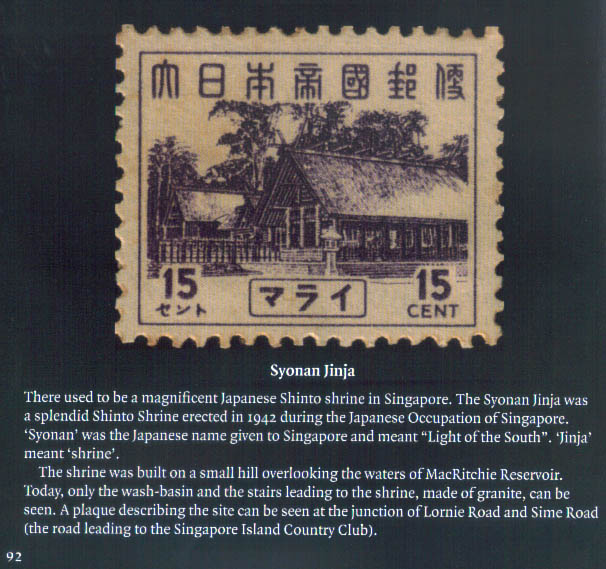
Syonan Jinja
There used to be a magnificient Japanese Shinto shrine in Singapore. The Syonan Jinja was a splendid Shinto Shrine erected in 1942 during the Japanese Occupation of Singapore. ‘Syonan’ was the Japanese name given to Singapore and meant “Light of the South”. ‘Jinja’ meant ‘shrine’.
The shrine was built on a small hill overlooking the waters of MacRitchie Reservoir. Today, only the wash-basin and the stairs leading to the shrine, made of granite, can be seen. A plaque describing the site can be seen at the junction of Lornie Road and Sime Road (the road leading to the Singapore Island Country Club).
Page 91

Horsburgh Lighthouse
Lighthouses play an important part in the safe passage of ships through rocky waters. Singapore has several lighthouses built for this purpose and three of them were featured on stamps in 1982.
Horsburgh Lighthouse, built in 1851, is located about 65 km south-east of Singapore. The lighthouse stands on a rocky outcrop, known as Pedra Branca, in the South China Sea.
Malaysia has in recent years claimed sovereignty over Pedra Branca. Both Singapore and Malaysia submitted their case to a third party, the International Court of Justice in The Hague, in 2003.
Raffles Lighthouse
Raffles Lighthouse, built in 1855, is located about 20 kilometres south of Singapore. The small island on which Raffles Lighthouse stands is known as Pulau Satumu.
An additional feature on Pulau Satumu is a 40-metre signalling tower which warns other ships when a super oil-tanker (a very large ship) is in the vicinity. These super oil-tankers are very big and need a few kilometres of space to come to a complete stop. Incidentally, the numerous oil-tankers bring in a lot of crude oil for refining. Singapore may be small but it has become one of the world’s largest oil-refining centres.
Page 90
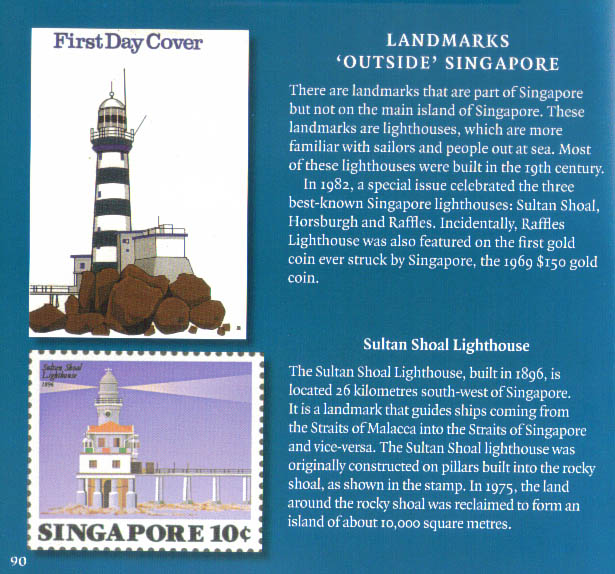
LANDMARKS ‘OUTSIDE’ SINGAPORE
There are landmarks that are part of Singapore but not on the main island of Singapore. These landmarks are lighthouses, which are more familiar with sailors and people out at sea. Most of these lighthouses were built in the 19th century.
In 1982, a special issue celebrated the three best-known Singapore lighthouses: Sultan Shoal, Horsburgh and Raffles. Incidentally, Raffles Lighthouse was also featured on the first gold coin ever struck by Singapore, the 1969 $150 gold coin.
Sultan Shoal Lighthouse
The Sultan Shoal Lighthouse, built in 1896, is located 26 kilometres south-west of Singapore. It is a landmark that guides ships coming from the Straits of Malacca into the Straits of Singapore and vice-versa. The Sultan Shoal lighthouse was originally constructed on pillars built into the rocky shoal, as shown in the stamp. In 1975, the land around the rocky shoal was reclaimed to form an island of about 10,000 square metres.
Page 89

The stamps in this series also feature some of the wildlife found in the MacRitchie catchment area. The first stamp on the left depicts the Colugo (Cynocephalus variegatus) or Malayan Flying Lemur. The second stamp features the Singapore Adenia (Adenia macrophylla var. singaporeana), a rare forest-edge species which is found in Chek Jawa and along the pipeline in the Central Catchment Nature Reserve. The third stamp shows the Red-Crown Barbet, a colourful bird named Megalaima rafflesii, after Sir Stamford Raffles. The final stamp features the Common Tree Nymph (Idea stolli logani), a large beautiful butterfly with a wingspan of about 180mm.
Page 88
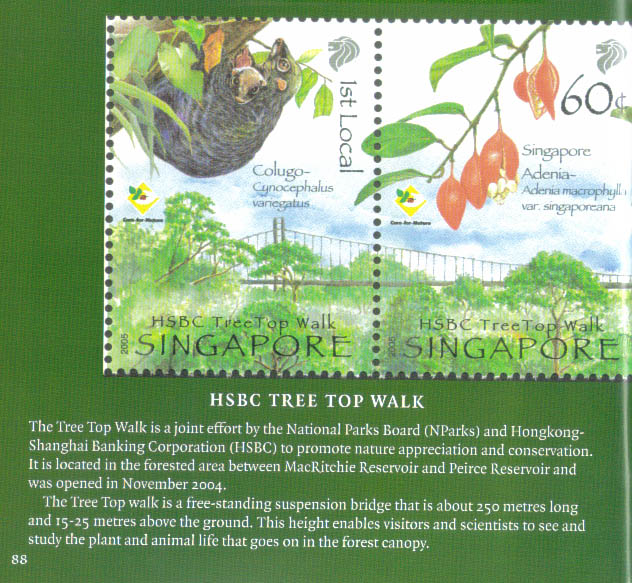
HSBC TREE TOP WALK
The Tree Top Walk is a joint effort by the National Parks Board (NParks) and Hongkong-Shanghai Banking Corporation (HSBC) to promote nature appreciation and conservation. It is located in the forested area between MacRitchie Reservoir and Pierce Reservoir and was opened in November 2004.
The Tree Top Walk is a free-standing suspension bridge that is about 250 metres long and 15-25 metres above the ground. This height enables visitors and scientists to see and study the plant and animal life that goes on in the forest canopy.


 ReTRIeVIA